
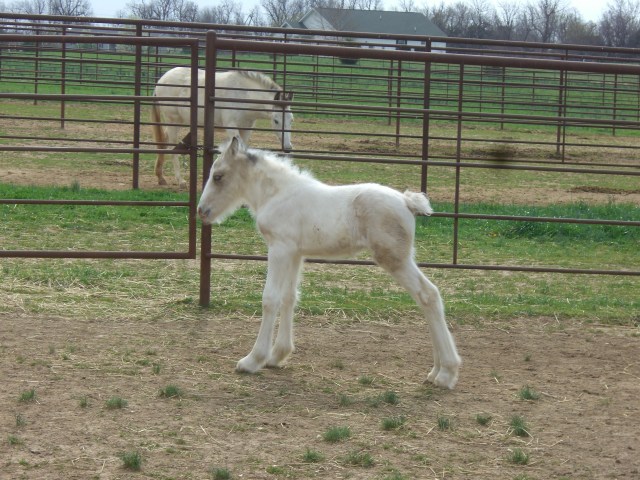
Number Four….already training for that “look at me” position!
Number Four….already training for that “look at me” position!
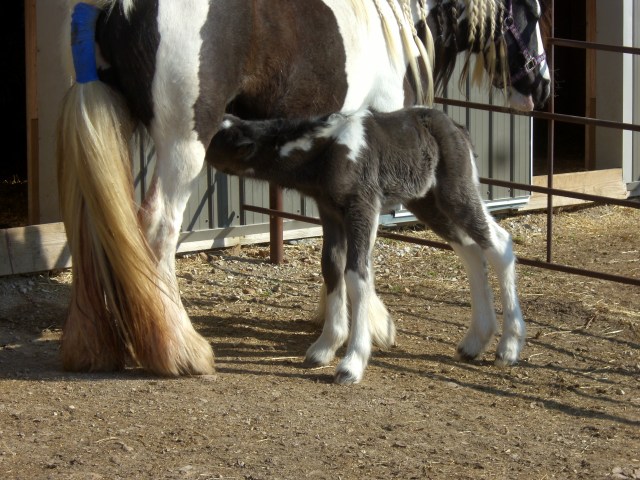
Just a few hours old and outside for first time, this little filly has got the milk bar routine down pat. Everything has gone smoothly from start to finish, THANK YOU GOD!!! Seriously, I pray for my horses, for their well being and often, just to help me understand what I don’t know. Still working on the “Poop” post, just in case you were wondering!
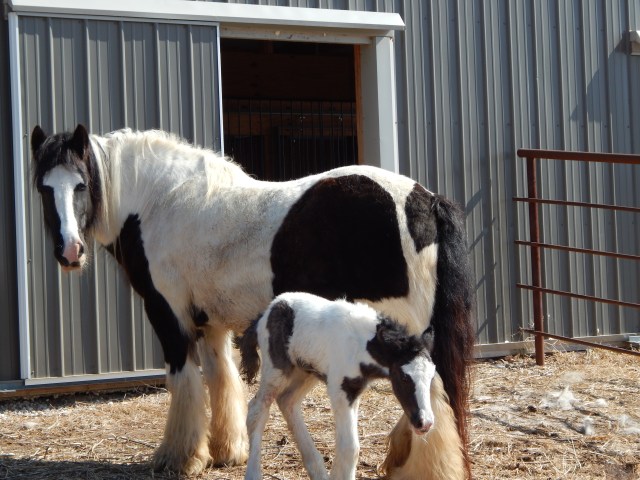
The first of what turned out to be five fillies! Five in Five! The day began as every day, Dudley waking me around 5am…it is March and it is dark! But I made a cup of tea thinking, I will get him fed and do my morning pages ( an exercise in creativity) before heading for the barn to check the mares. Only two are in, one ready to foal and the other to keep her company. Isolation is not a calming situation for horses or anyone accustomed to a support system. Soon, the cup is empty and “morning pages” and complete. Note: I am writing about ‘Poop” this am. Having heard the second time Lois Lerner of the IRS has taken the fifth ( a denial to tell the truth about her knowledge of the events that led to the discovery the IRS had been discriminating against certain non-profit applications and politically connected organizations and individuals.) The whole ‘poop’ idea just evolved …..guess you will just have to read it. In the meantime, enjoy the babies as we post them the day of their arrival…even if it is in hindsight! You will see them in the order they come into the world. This one will be registered as CHF Talbot’s Tillie.
Edie was a golden horse. A lovely little bay mare with a heart of gold. CHildren, the handicapped, elderly, you, me….everyone, she could shift gears …from a barrel horse, to a lovely slow and careful caretaker of a child or handicapped.
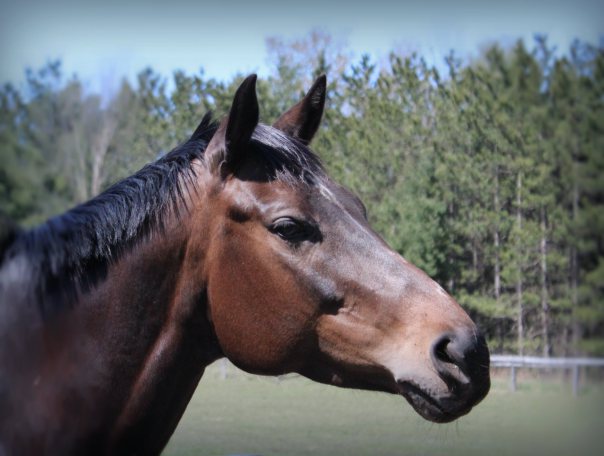 Credit: NBanaszak Photography
Do you have a Golden Horse? You can spot him from a mile away.
He is “golden” because of his heart of gold. This is the horse that takes care of you even more than you take care of him. You know you can rely on him to not spook, not get unnerved and let you enjoy what it was you set out to do. In fact, it seem that he enjoys his job even more than you do!
If you have a Golden Horse, you will soon realize how lucky you are. You will never want to part with him. Because as you learn and grow through his graciousness, you realize how much you are benefiting from him, and how much he is giving you. Every ride becomes a gift and every workout is easy because of his willing nature. You become the rider of your dreams…
View original post 227 more words
This article leads me back to my warning over 2 years ago about the dreaded Yellow Foxtail weed. It is becoming more and more invasive as we experience drought conditions followed by wet conditions. Many hay farmers are looking for solutions to eradicate this particular variety of weed but have yet to solve the issue.
I couldn’t help noticing this winter, while a batch of hay containing loads of thick stalks and the pesky Yellow Foxtail weed was being fed, how the horses became more cranky, more nervous and actually began bucking and kicking out behind.
 |
| Yellow Foxtail |
When I first saw the hay, which can look harmless until you open up the bale and see the seed heads and stalks, I checked the horse’s mouths and sure enough the ulcerated sores were starting to accumulate from the stickers of the foxtail seed head and the tough thick stalks of the plant.
I immediately began taking it out of the stall and replacing it with good hay or I would pick out the foxtail the best that I could. But that still was not enough to keep the horses free of it.
I kept noticing how the horse’s behavior was changing as they ingested this hay and it reminded me once again how most of horse’s behavior issues are related to their internal systems.
Besides the mouth being uncomfortable with ulcers, the intestinal tract was the most affected especially in the cecum and small intestine which is located near the right hind flank of the horse. Horses with an inflammation or “IBS” irritable bowel syndrome from ingesting weeds, sand, chemically treated grass or other irritants will begin by being fussy or restless. They will begin to pin their ears, become highly sensitive to touch and grooming, become distant and resistant to being handled. That condition if not handled right away will then turn into bad behavior issues.
The horse will not have any other way of acting or telling you they are very uncomfortable and when they move in certain ways the IBS hurts. With the foxtail stickers they will actually flinch when they are pricked in their colon.
A horse in this condition will not want to carry a bit, a saddle, have a girth tightened, have a rider mount or work where the IBS condition will always be on their mind and emotionally and physically causing trauma. They can become dangerous and may become a bucker, spooker or refuse to let you mount.
So before anyone gets hurt you can intervene and make sure the problem does not escalate to the horse becoming dangerous and demonstrating severe pain. Always use The InBalance Horse essential oil blend every time you work with your horse to help your horse’s nervous system especially while they are uncomfortable and in pain.
1) Take out foxtail seed heads:Take precautions by opening each bale of hay before it is fed and make sure there is no sign of yellow foxtail seed heads and thick stalks and sticks.
The soft green foxtail seed heads are fine and easily digested.
2)Throw away or give to ruminants: If you do find bales with these weeds throw them off to the side and give them to ruminant animals.
3) Check your horse’s mouth for ulcers on the insides of the lips, gums and cheeks. Use an iodine/water (1 drop of pure iodine to 1 oz. of water ratio) drench and Campho-phenique on the ulcers for a few days until they soften and dissolve.
4) Immediately place 1 tablespoon of Epsom Salts in your horse’s feed twice daily. You can also put the salts in the horse’s water bucket. (You can use any Epsom Salts from a grocery or drug store). Do this for 10 days then reduce to 1 Tablespoon daily for 2 weeks until you see your horse return to calm, relaxed and happy status.
5) Also feed a probiotic. I like to use Blue Ridge Distribution natural Probiotic. But there are many on the market. Feed this supplement for at least 2 weeks while the enzymes are re balancing the gut.
6) And you can also add an ulcer aid or intestinal relaxant with herbs while the horse is healing for a few weeks. Remember you are working with healing the gut and the emotional state!
7) Another solution to this issue is to add Chia seeds to your horse’s ration daily. Go To US Chia to learn all about chia grown in Kentucky and produced for the horse market. This seed goes a long way to alleviate any debris, inflammation or obstruction in the intestinal channels. The minute the seeds hit moisture they turn into a gel and become like a bubble blob moving through the smooth muscles of the digestive tract. They also contain more Omegas than fish or flax oil. Give it a try. I love it for me and the horses!
8) If you can or if you have a professional that can help you use therapy. Energy work will move energy from head to tail and ask the horse to help you move the muscling around the gut area. Horse’s in pain and discomfort many times will shut down and become stagnate. We want the energy increased to flush and heighten the movement of the gut outward. I use dowsing and acupressure methods to do this with the horse and they always appreciate it greatly.
Once you have followed this protocol and the horse is not ingesting the irritant anymore your horse should become relaxed and happy to work again. The bucking, spooking, bad behavior and attitude will cease. But be sure to understand the horse needs to be told by you and reminded by you that he or she is okay now and they don’t have to worry about being in pain anymore. If this behavior starts again you now know what to do.

By Teresa van Bryce
A professor of Animal Sciences at Colorado State University, Dr. Temple Grandin is a world famous expert in animal behaviour and livestock handling. While renowned for her innovations in the design of handling facilities and improving animal welfare in the livestock industry, Dr. Grandin is perhaps best known for overcoming her personal struggles with autism. She continues to teach and pursue her research while lecturing around the world on autism and livestock handling.
Teresa van Bryce: What would you say are the most common misconceptions owners have about their horses’ behaviour?
Dr. Grandin: The most common mistake that’s made in behaviour with any animal is mixing up fear and aggression. Fear and aggression are two different emotional systems. You don’t want to be punishing fear. The other thing about animal behaviour is that the horse doesn’t have language, so the only way it’s going to store memories of good or bad things is a picture, a smell, a touch, a feeling, or something it hears. They make associations with something they were seeing or hearing right when something bad happened. There’s a horse I talk about who is scared to death of black hats. White hats are fine, black hats are bad. It’s sensory based, not word based.
TvB: So when you speak of “thinking in pictures” and animals doing the same, is this what you’re referring to?
Dr. Grandin: If I ask you to think of a church steeple, how does it come into your mind?
TvB: I see it. It’s a picture in my mind.
Dr. Grandin: Now, is it a generalized steeple or a specific one in a specific place?
TvB: Generalized, I would say.
Dr. Grandin: That’s what most people do – generalize. Now, people who tend to be more visual, like me, see specific steeples. This is visual thinking, or bottom-up thinking. I form my concept of what a church steeple is by taking specific pictures and putting them in the church steeple file folder in my brain. There’s no other way an animal can store its memories without verbal language. For example, there was a study done where a horse was habituated to the sudden opening of a blue and white umbrella. But being habituated to a blue and white umbrella does not transfer to an orange tarp because it looks completely different. When a horse gets afraid of something, it tends to be fairly specific.
I talked to someone who had a horse that was terrified of long, straight things, like shovel handles. We got to talking about his history and it turned out this horse had been in cross ties, flipped over backward, and a thick lead rope fell right across his chest. It appeared as a long, straight thing to the horse and so he associated long, straight things with hurting. It’s a fear memory.
TvB: So how do we deal with these issues in our horses?
Dr. Grandin: First of all, we want to try to prevent them. Let’s get rid of things like rough training methods. If you have a horse that’s been abused with a wire snaffle bit, he might see all jointed bits as bad. Get rid of the jointed bit and he’ll be fine because now you’re in a different file.
Now, because I can’t get rid of black hats I have to work out how I’m going to desensitize that horse around black hats. My success is going to vary depending on the flightiness of his genetics. A very flighty horse may never be safe around black hats. The problem with fear memories is that there is no erase. You train the brain to suppress the fear but, if the horse is tired or not with his familiar person, it comes back.
There was a horse in California they used in the feed yards. He’d been in a roping accident, and if anything touched him on the rear he’d get very upset. Holstein cattle will lick a horse if he’s standing in the paddock. If this horse had his favourite rider on him when a cow licked him, the rider could calm him down. The feedlot manager made the mistake of letting someone else ride the horse. A Holstein came up and touched his rear and the horse exploded, went into the fence, and broke his leg. You can suppress it but it’s only suppression.
|
“The horse doesn’t have language,” explains Dr. Grandin. “The only way it’s going to store memories of good or bad things is a picture, a smell, a touch, a feeling, or something it hears…it’s sensory based, not word based.” |
I have people say, “My horse is fine at home but we went to a show and he just exploded.” Let’s look at the things we have at a show that you don’t have at home – baby carriages, flags, bikes, balloons. You’d better get him used to that stuff before you go to the show. The best way to teach your horse to tolerate balloons and flags is to decorate his pasture with them and let him voluntarily approach. Don’t take balloons and flags and shove them in his face.
TvB: If work with balloons and flags doesn’t translate to other objects, he’s going to be afraid of something else. So does desensitization help?
Dr. Grandin: Think about it in a visual way. Take an American flag and a Canadian flag. That’s going to transfer, because the way it moves and the approximate shape is the same. But you would need to habituate a horse to pennants because visually they are different than the flag you’d carry for the rodeo parade. Just like the generalizing from the rope to the shovel handle, it’s an approximate shape.
If you want to understand how a horse experiences something, you’ve got to get away from verbal language. You’ve got to start thinking about things visually. Your horse that you’ve habituated to balloons, if he’s only seen single balloons and now is presented with a bunch of balloons, it looks very different.
TvB: When you’re working with horses, there are many different training methods using either positive or negative reinforcement. Which works better in your opinion?
Dr. Grandin: Basically, my approach to animal training is totally positive with one exception – serious aggression. Let’s say I have a horse come at me, teeth bared, full aggression. I’m going to react not very positively. He’s going to run into serious consequences. There’s sometimes a place to use a very severe aversive, once or twice, that’s all. But everything else, when you’re trying to teach an animal how to do a new task, that should always be positive. I think people need to look a lot more into clicker training and things like it. This is the approach you need to be using.
TvB: What if you have an unwanted behaviour in a horse, like pawing?
Dr. Grandin: Make sure you’re not accidentally reinforcing that behaviour. If your horse paws when you go to feed him, don’t put the bucket down when he’s pawing. Wait until he stops and then give him the bucket. Then gradually lengthen the amount of time he has to not paw in order to get the grain.
TvB: And if he paws for half an hour?
Dr. Grandin: I don’t care. He’s not going to get the grain. He doesn’t get the thing he wants until he stops pawing. He stops for a second, you put the grain down. You’ve got to get your timing right. This is one of the advantages of clicker training. You can more easily time the reward stimulus, the click.
Don’t reward bad behaviour. When horses push on you for a treat, they don’t get the treat until they stop pushing. It’s the same with cattle. I get cattle mobbing me at a gate because they want to switch pastures. I’m not going to open the gate until they stop doing it. I might have to stand there for two hours until I open that gate, but having that patience in the beginning pays off. You can usually teach manners by withholding a reward and continuing to extend the amount of time they have to wait.
TvB: Canadian horse slaughter plants have been under fire recently. From your experience designing and auditing humane handling facilities, are the plants in Canada doing a good job?
Dr. Grandin: The plants up here, when I’ve gone to visit them, were fine. But then, when my back was turned, someone got a TV camera in there. The plant in Quebec was using a beef stunning box and the horse could see over the top of the box onto the kill floor. That’s just stupid, and to fix it is simple. Another plant had horses slipping on the floor. Well, put non-slip flooring in there. The other thing you have to have for humane slaughter, and when the plants are short-staffed they don’t want to do it, is two people to run the stun box. You don’t need a complicated design, just non-slip flooring, high sides on a well-lit box, and two people to run it.
It doesn’t require fancy equipment to run humanely but it does require management that cares. They ought to be putting video auditing in the slaughter houses. I think they should just put a camera in and stream it out to a web page. Let the public monitor it.
TvB: Has the closure of the slaughter plants in the U.S. impacted equine welfare?
Dr. Grandin: In the U.S. we have terrible problems – neglected horses, rescues overflowing. The problem is that half the horse industry really objects to the idea of eating them, but nobody has any practical solutions. We’ve got 2000 horses a week going to Mexico. Half of these may be going to fairly decent export approved abattoirs but the other half are going to local abattoirs and being killed by punctilla, which is stabbing the horse in the back of the neck.
I asked activist groups to give me some alternatives to slaughter that I would present to a horse summit two years ago, things like bigger rescue places, euthanasia stations, dude ranches, etc. I presented these things and haven’t had one of them follow up with me as to whether or not any of these things were done. They don’t have a practical solution to the problem. I think that horse slaughter in a decent plant is a better alternative to starving. The problem on these issues is that people are so far away from the practical realities of things.
Main Article Photo: Rosalie Winard – Dr. Temple Grandin is renowned for her innovations in livestock handling and overcoming her personal struggles with autism.
This article originally appeared in the April 2013 issue of Canadian Horse Journal.
As many of you may know, Otis is named for a gentleman no longer with us but remembered every day. It seemed only fitting we should name this colt Otis. Like his name sake, he is calm, laid back, and just doing what ever needs done. In the colt’s case, it is learning whatever needs to be learned. Talk about a quick study! Something typical of the breed or Gypsy Vanner, being a quick study is all about how they learn. Take the gentleness of the draft and the smart resourcefulness of the pony heritage, and you have, truly, the best of both worlds. Give this breed a job to do and as soon as they understand, which is quickly, they are on it. They make everything look easy. We are so accustomed to doing everything over and over and previously, our light horses needed more and more, but this is training on the fast track. Don’t skip steps because it is a foundation you are building, and imperative your horse understands the ask or he will give you an answer you don’t want or expect. They represent all personalities as in all breeds, but coupled with a strong desire to please and smart enough to get it quickly you have a trainer’s dream. Maturity is a big factor to be considered as well, as some need a longer period to grow up. We have a small gelding, CHF Traveler, that was so ultra smart as a youngster, he would have taken advantage of anyone lacking experience and common sense. He could have been sold over and over again to moms and grandmas looking for a small horse for their daughter, granddaughters, sons, or grandsons. To those, I thanked but shared, he would not be the horse you want for this child. Now, a few years later, he is amazing. We drive him and will put him under saddle this spring for two reasons. First of all, to enhance his self confidence. And yes, horses need to become confident in their relationship with you. They need to trust you and know without doubt, whatever you ask of them, they will be safe. Second, it gives Traveler the chance to become some special child’s best buddy. And when they outgrow him, size wise, grandma can get out and have some fun driving him. It is a win win for everyone. 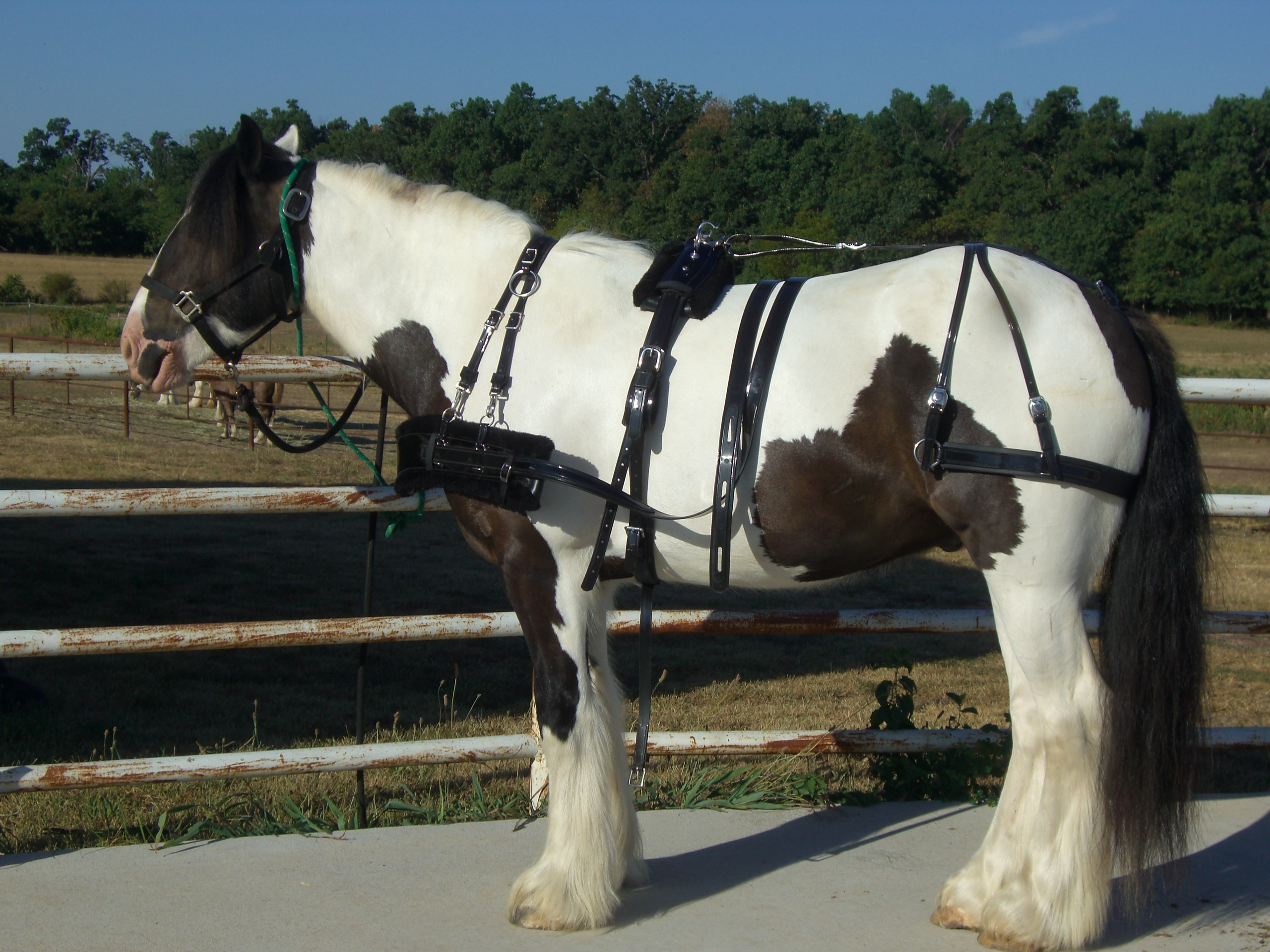

Almost a year old, Otis is an exceptionally calm Gypsy Vanner!
 The average horse, with a lower activity level, should eat between 1.5 and 2% of its body weight in feed per day to maintain weight.
Photo: Photos.com
Bitter cold temperatures have been a theme this winter, and are now here again. To that end, experts at the University of Kentucky (UK) College of Agriculture, Food, and Environment offer tips for managing horses during extremely cold weather.
While the ideal time for cold weather preparation is in the fall, there are expert-recommended tips to help keep your horses healthy now. According to Bob Coleman, PhD, PAS, Extension horse specialist in UK’s Department of Animal and Food Sciences, horse owners should also think about preparing for acute vs. chronic cold. Acute cold is found in the cold snaps that last for a short period of time. Chronic cold is the cold that takes hold and stays with a region for a much longer duration. Sometimes an acute situation can prove to be more dangerous to animals, he said, because they aren’t as used to the cold and owners might not be as well-prepared as those in locations where intense cold is more typical and long-lasting.
Regardless of the type of cold present, horse owners should make sure animals have adequate shelter, water, dry bedding, and feed, he said.
Coleman explained that digestion is one way horses can generate heat when it is cold. The average horse, with a lower activity level, should eat between 1.5 and 2% of its body weight in feed per day to maintain weight.
Feed requirements go up as temperatures drop and horses use more calories to keep warm. Mature horses can, when adapted, handle a temperature of 5°F, which is called the lower critical temperature, he said. When the temperature falls below this, the horse needs to increase heat production or reduce heat loss to maintain core body temperature. One way to do this is for the horse to eat more. A drop in temperature to -5°F will require an additional 15% more forage to provide the needed calories, meaning the horse needs to eat 2 to 3 more pounds of hay each day.
“As a horse owner, making sure there is some extra hay available will help your horses get through the short-term cold snaps. Long or more chronic exposure to cold will need some other management changes to meet the horse’s calorie needs,” Coleman said. “On the short-term, add more forage. But if forage supplies are limited, adding a concentrate feed to the diet may be needed.”
For mature horses at maintenance, good quality legume-grass mixed hay should be adequate, while young growing horses or broodmares in late gestation will likely require a concentrate in their diets to meet the increased calorie needs. If an owner is adding concentrate for the first time, those additions should be made gradually to prevent digestive upsets.
Coleman said it’s also critically important that horses to have access to clean, unfrozen water to ensure that they eat adequate amounts of feed. Daily water intake helps to reduce the risk of colic due to impaction. While this can be one of the most difficult and time-consuming aspects of winter horse management, its importance can’t be over-emphasized.
In addition, horses will need shelter to provide protection from the wind and any precipitation that may fall.
For horse owners who choose to use blankets, Coleman urged them to make sure those blankets are both wind and waterproof. A wet blanket equals a wet horse, and that wetness disrupts the hair coat’s ability to insulate the animal and can quickly lead to cold stress.
All horse owners should take extra time observing horses during cold snaps to make sure they are okay. This means checking on horses daily. Ones who are feeling the effects of the cold will need extra attention.
One last bit of advice? Coleman strongly recommended keeping horses out of pastures or paddocks with ponds or other open water sources. There are cases each winter of horses falling through ice and into a pond.
Holly Wiemers, MA, is communications director for University of Kentucky Ag Equine Programs


 Photo: Rosalie Winard


 chocolatehorsefarmgypsyhorses